

Mother’s Day Art Camp
May 02@ 1:30 am—4:30 pm


In April’s installment of our year-long series celebrating America’s 250th birthday, we sit down with America’s second president. John Adams – the argumentative lawyer who pushed for independence, the diplomat who secured crucial alliances, the leader who proved democracy could survive the peaceful transfer of power – shares his thoughts on the exhausting work of self-government and what it means when desert town citizens can actually hold their officials accountable.
From defending British soldiers after the Boston Massacre to becoming president, from bitter rivalry with Jefferson to their final reconciliation, Adams embodied both the promise and the difficulty of building a republic. What would he think of Oro Valley’s transparent town council meetings? What warnings would he offer about political parties? And what would he say about his famous friendship with Jefferson?
Discover the complicated, brilliant, difficult man who helped build American democracy – and learn why his insistence on competence over charisma still matters 250 years later.
Part of ILoveOV.com’s special series: Conversations Across Centuries
In our fourth installment of Conversations Across Centuries, we sit down with America’s second president. John Adams – lawyer, diplomat, independence advocate, and political philosopher – shares his thoughts on the messy work of building a republic, the friendship that defined his life, and what it means to govern a town you’ve never heard of in a desert you never imagined.
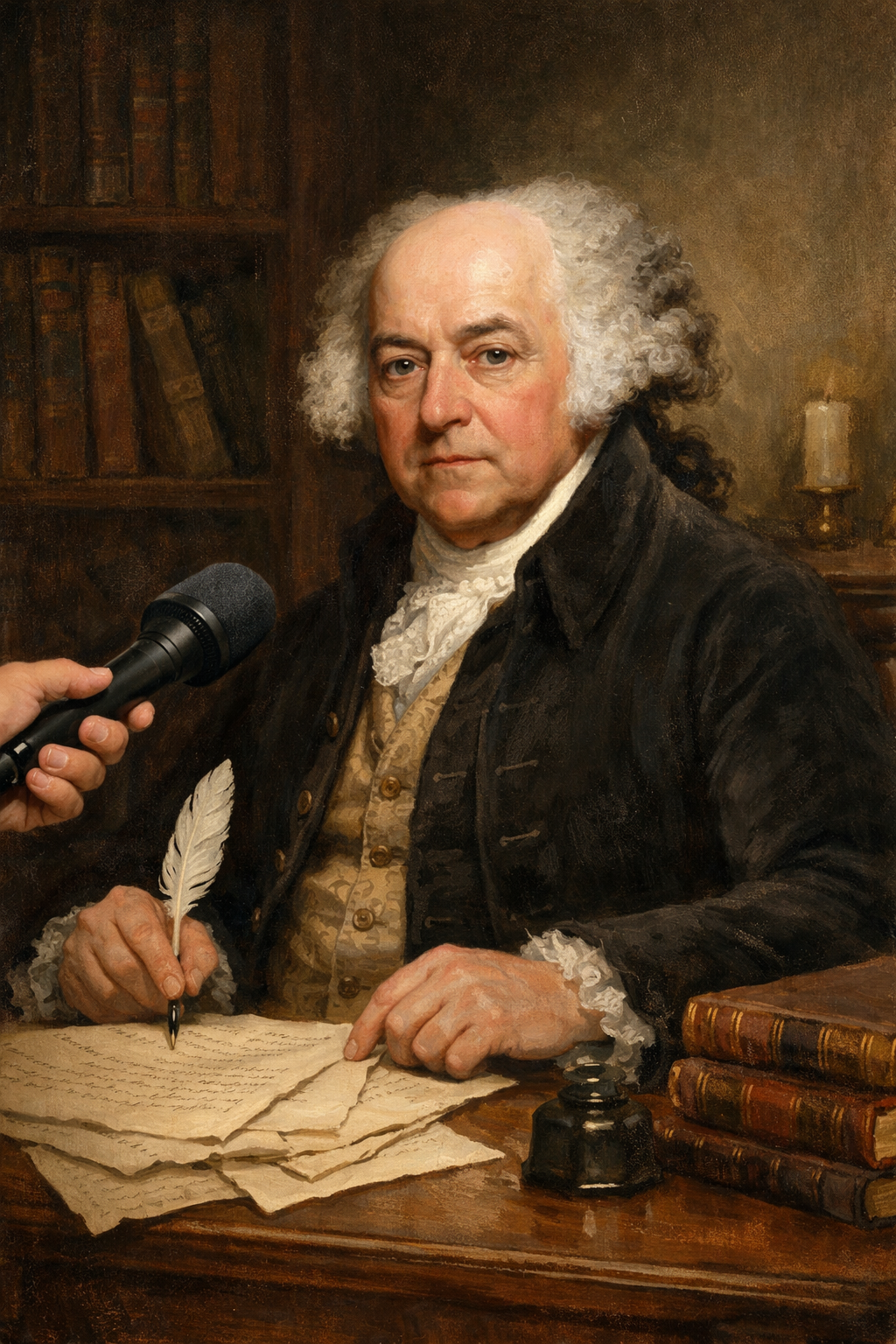 Mr. President, thank you for joining us. What motivated you to risk everything for independence?
Mr. President? I spent four years earning that title and forty years trying to escape its shadow. Call me Adams, or John if you must – though Abigail’s the only one who could get away with that without my grumbling about it.
What motivated me? Principle. Stubborn, inflexible, utterly impractical principle.
I was a successful lawyer in Boston with a growing practice, a family, and a farm. I had everything to lose and, frankly, a temperament poorly suited for revolution. I’m argumentative, vain, impatient, and I’ve never met a slight I couldn’t nurse into a grievance. Ask anyone who knew me – I’m difficult.
But I’m also a lawyer, and lawyers traffic in precedent and rights. When Parliament claimed the right to tax us without our consent, when they quartered soldiers in our homes, when they closed Boston Harbor as collective punishment – these weren’t just inconveniences. They were violations of English common law, of rights we’d inherited as subjects of the Crown.
I argued the Boston Massacre case, defending British soldiers who’d killed colonists, because everyone deserves legal representation. The rule of law isn’t optional; it isn’t based on popularity. But when the Crown itself abandons the rule of law? Then what choice remains except resistance?
I pushed for independence at the Continental Congress when others still hoped for reconciliation. Not because I was brave – I’m a coward about physical danger, truth be told – but because I could see no logical alternative. Britain wouldn’t compromise, we couldn’t continue as we were, therefore independence was inevitable. Sometimes stubbornness masquerades as courage.
What was your greatest fear during the Revolution?
That we’d succeed in winning independence but fail at everything that came after.
Military victory was always uncertain, yes. But my deeper fear was that we’d prove incapable of self-government. That we’d fracture into thirteen petty republics, squabbling and weak. Or worse, that we’d replace British tyranny with American tyranny – that we’d simply trade one master for another.
**[Editor’s Note: Adams’ fear about Americans proving “incapable of self-government” resonates powerfully in 2026. As Oro Valley residents watch national politics fracture along partisan lines, as Congress struggles to pass basic legislation, as compromise becomes a dirty word rather than a democratic necessity, we’re living inside Adams’ nightmare scenario. He didn’t fear losing the war as much as he feared winning it only to discover we lacked the discipline, patience, and civic virtue required to maintain a republic.
His warning wasn’t about external threats – it was about internal collapse. About citizens choosing faction over nation, comfort over participation, grievance over compromise. As we celebrate 250 years of American democracy, Adams would likely ask us: Are you still capable of the work self-government requires? Or have you proven his deepest fear correct?]**
I also feared for my family. When I left for Philadelphia, for Europe, I was abandoning Abigail to manage everything – the farm, the children, the finances – during a war. She was extraordinary, far more capable than I deserved, but the fear never left me. What if I returned to find them lost to disease, or violence, or simple misfortune?
What compromises did you make that still trouble you?
The Alien and Sedition Acts. That stain won’t wash off.
In 1798, war with France seemed imminent. The nation was divided, seditious libel against the government was rampant, and I convinced myself that restricting speech critical of the government was necessary for national security.
I was wrong. Profoundly, dangerously wrong.
I became what I’d fought against – a leader using power to silence critics. I justified it as temporary, as necessary, as different from British tyranny. But tyranny rarely announces itself as tyranny. It arrives dressed as security, as necessity, as reluctant duty.
Jefferson defeated me in 1800 partly because of those acts, and he was right to oppose them. Free speech, even seditious speech, is the price of liberty. I knew that – I’d argued it myself – yet when power was mine, I betrayed the principle.
I also compromised my integrity with political appointments. The “midnight judges” I appointed in my final hours as president were qualified men, yes, but I was also stacking the judiciary against Jefferson out of spite. That was petty, beneath the office, and I’ve regretted it.
What would surprise us most about daily life in your era?
Travel was exhausting. Everything took forever.
When I served in Philadelphia, it was a week’s journey from Massachusetts – if the weather cooperated and I didn’t get sick, which I often did. A trip to Europe? Six weeks by ship if you were lucky. I spent more time traveling to diplomatic posts than accomplishing anything at them.
You modern Americans with your instant communication and rapid transportation – you can’t comprehend the isolation. When I was in France negotiating treaties, Abigail and I would go months without word from each other. I’d write letters not knowing if she was alive to receive them.
Also, how much of the government happened in person, in private conversations. There was no mass media, no instant news. Policy was made in drawing rooms and taverns through persuasion, argument, and compromise. You had to be physically present to influence events.
And the lack of privacy in public life. Every letter could be intercepted, every conversation overheard. Political enemies published private correspondence to embarrass you. Your reputation could be destroyed by a pamphlet, and you had no rapid way to respond. Franklin understood this – he was careful, diplomatic. I never learned the skill.
If you could witness one moment 250 years in the future – 2026 – what would you want to see?
The peaceful transfer of power between political opponents.
That was my gift to America, though few appreciated it at the time. In 1801, after Jefferson defeated me in a bitter, vicious election, I left Washington before his inauguration, which historians call petty, and perhaps it was. But I left. I transferred power to a man I considered dangerous, whose philosophy I opposed, whose supporters had slandered me mercilessly.
And the republic survived.
That’s the test of a democratic system – not whether you transfer power to allies, but whether you surrender it to enemies and trust the system to endure. In 1801, that was unprecedented. Every previous government in history had required force to change leadership.
So I’d want to see if you’ve maintained that tradition. Do political opponents still yield power peacefully? Or have you slipped back into humanity’s default setting: might makes right?
I’d also want to see whether you’ve avoided the trap of political parties. I warned about this in my presidency – that faction would tear us apart, that loyalty to party would supersede loyalty to nation. Did you listen? Or did you prove me right?
You’re told that Oro Valley, Arizona – a town of 50,000 in the desert – holds regular town council meetings where citizens can address their elected officials, that council votes are public, and that all government business is conducted transparently. Your reaction?
A town of fifty thousand, and they haven’t appointed a mayor for life? Do they actually hold elections? Do the citizens have direct access to their representatives?
That’s remarkable. That’s what we were attempting to build.
Tell me: How often are these council meetings? Monthly? How many citizens actually attend? Because transparency without participation is just theater – officials performing accountability for an empty house.
And when citizens address the council, do the officials actually listen? Or is it merely a ritual where common folk vent and nothing changes? I’ve seen both models in New England town meetings.
Arizona, you said – desert territory. How did it become a state? Did the original thirteen expand westward peacefully, or was there conflict? Did you maintain the principle that new states enter as equals, not as colonies?
And this Oro Valley council – what powers do they exercise? Are they merely administrative, handling local roads and disputes? Or do they have genuine authority over taxation, regulation, and law enforcement? Because local self-government only matters if it has teeth.
The transparency interests me most. In my day, so much government happened behind closed doors – often necessarily so, when dealing with foreign powers or sensitive security matters. But local government? Town councils? There’s no excuse for secrecy there. The people have every right to know how they’re being governed.
If Oro Valley’s citizens can attend meetings, speak freely, observe votes, and hold officials accountable – and if those officials face regular elections where they can be removed – then you’ve achieved something we only theorized about. Most humans throughout history have lived under governments that rule them, not governments that serve them.
Is it working? Or have you discovered, as I feared, that self-government is exhausting and most citizens prefer to complain rather than participate?
What advice would you give Americans celebrating the 250th birthday?
First: Remember that democracy is work. Constant, unglamorous, frustrating work. It’s attending meetings, reading legislation, understanding issues, voting in every election – including the boring local ones. The moment citizens become passive, they invite tyranny. Self-government isn’t a machine you build once and forget. It’s a garden requiring constant tending.
Second: Respect your political opponents. I failed at this spectacularly. Jefferson and I became enemies over policy differences, spent years in bitter rivalry, and nearly destroyed our friendship. It took us decades to reconcile, and when we finally did – through letters in our old age – I realized how much time we’d wasted hating each other.
You can profoundly disagree with a policy while recognizing your opponent’s patriotism. The moment you decide that people who disagree with you are enemies rather than fellow citizens with different ideas, you’ve begun the dissolution of the republic.
Third: Value competence over charisma. I lost to Jefferson partly because he was graceful, eloquent, inspiring – everything I wasn’t. But competence matters more than inspiration. Choose leaders who understand government, who’ve actually accomplished things, and who can handle the tedious work of administration. Democracy needs dreamers, yes, but it runs on competent bureaucrats.
Fourth: Read. Everything. Constantly. I read law, philosophy, history, science, and literature in multiple languages. An ignorant citizenry cannot maintain liberty. Your opinions should be informed, your arguments grounded in evidence, and your positions changeable when presented with better information.
Fifth: Maintain the balance between federal and local power. Too much centralization destroys local initiative. Too much localism prevents national coordination. The tension is deliberate – keep negotiating it.
Sixth: Eternal vigilance is the price of liberty. Government officials – including presidents – are human. They’ll make mistakes, abuse power, and prioritize their interests over yours. The system we built assumes this. Use it. Question authority, demand accountability, and never, ever assume that people in power have your best interests at heart just because they say they do.
Finally: Make peace with your enemies before it’s too late. Jefferson and I reconciled in 1812 and corresponded for fourteen years. Those letters – filled with philosophy, reminiscence, argument, and genuine affection – were among the most meaningful of my life. We died on the same day, July 4, 1826, exactly fifty years after independence.
That’s either providence or coincidence, but I choose to believe we timed our exits together, one last collaboration between old friends who’d wasted too many years apart.
Don’t waste your years. Life’s too short, and your enemies are often right about at least some things.
John Adams died July 4, 1826, at age 90, on the fiftieth anniversary of the Declaration of Independence. His last words were reportedly “Thomas Jefferson survives” – not knowing that Jefferson had died hours earlier at Monticello. Adams lived longer than any president until Ronald Reagan. He’s buried next to Abigail in Quincy, Massachusetts, in the church where they worshiped together. Their son, John Quincy, became the sixth president, making them the first father-son presidential pair.

;>)